Regret is like tears seeping through closed eyelids.
– Galway Kinnell, Pulitzer Prize for Poetry winner
Regret is a powerful human emotion.
I was reminded of this reality while searching through the Library of Congress (an impressive resource, by the way), inadvertently coming across old WWI propaganda.

Evening public ledger. (Philadelphia [Pa.]) 1914–1942, August 28, 1918, Final, Page 13, Image 13http://chroniclingamerica.loc.gov/lccn/sn83045211/1918-08-28/ed-1/seq-13/
There are a lot of powerful words used in wartime messaging like this.
Unless you play a man’s part now you always will be haunted by a feeling of shame — down in your own heart you will always despise yourself.
Ouch.
The words and phrases in this century-old newspaper clipping from Philadelphia are powerful because they tap into our immutable desire for significance. We all want to believe that our life has meaning and importance — that we have lived honorably.

Were YOU there then?http://hdl.loc.gov/loc.pnp/cph.3g12175
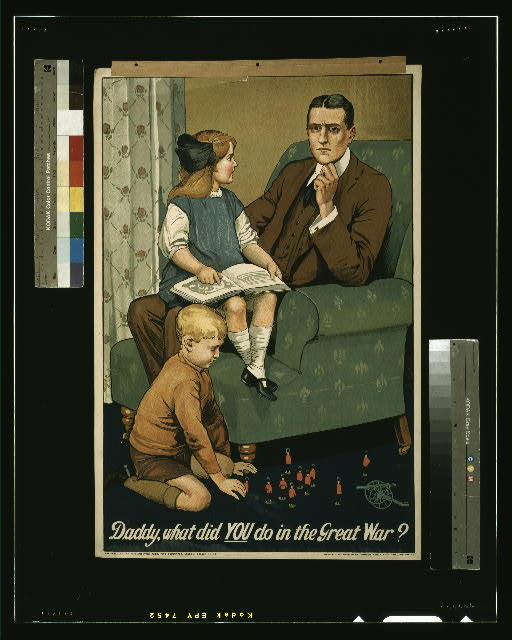
Daddy, what did you do in the great war?http://hdl.loc.gov/loc.pnp/cph.3g10923
I imagine those posters were quite effective, for good reason — they pull on our heartstrings and deepest emotions.
Grand pursuits are the antidote to regret— whether it is fighting for national security, building an extremely profitable business, raising strong children, or any number of pursuits of your own choosing.
But don’t fall for others’ guilt trips and the naive thinking that you can’t decide for yourself what you might regret. Humans are not very good at predicting the future, but it is worth trying to figure out.
There is absolutely more to living a quality life than just minimizing regret. Regardless, it’s a powerful lense through which to examine your life.
Two Testing Frameworks for Minimizing Regret
1. The Jewish Rabbi Test
Here’s a great quotation, attributed to Hillel the Elder (a famous Jewish religious leader from over 2000 years ago):
“If I am not for myself, who will be for me? And when I am for myself, what am ‘I’? And if not now, when?”Hillel, Pirke Avot I.14, translated Charles Taylor
In other words, if not me, who? If not now, when?
2. The Rocking Chair Test
Jeff Bezos, founder of Amazon.com, is famous for using this test to make a decision that led to quitting his lucrative job at investment firm D.E. Shaw in New York City.
I wanted to project myself forward to age 80 and say, “Okay, now I’m looking back on my life. I want to have minimized the number of regrets I have.” I knew that when I was 80 I was not going to regret having tried this. I was not going to regret trying to participate in this thing called the Internet that I thought was going to be a really big deal. I knew that if I failed I wouldn’t regret that, but I knew the one thing I might regret is not ever having tried. I knew that that would haunt me every day, and so, when I thought about it that way it was an incredibly easy decision. And, I think that’s very good. If you can project yourself out to age 80 and sort of think, “What will I think at that time?” it gets you away from some of the daily pieces of confusion.
– Jeff Bezos Regret Minimization Framework (http://bit.ly/bezosregretmin)
As a result of this test, Bezos became an ecommerce pioneer, eventually creating a juggernaut business than now employs over 200,000 people around the world.
Question: Do you have testing frameworks or mental models that you use to minimize regret?